
Concrete Patio Designs for Holly Springs Town Center Homes
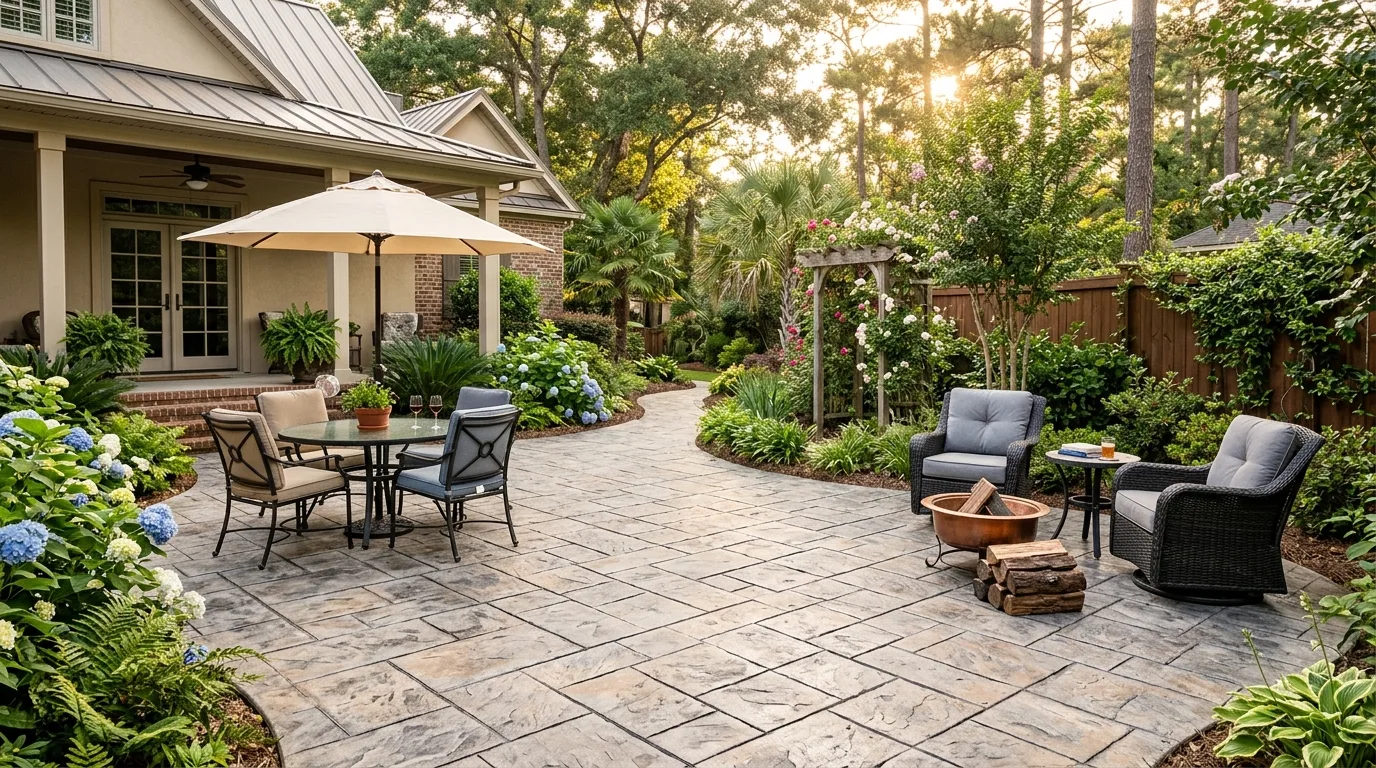
Holly Springs’s new Town Center development — a mixed-use amphitheater district with restaurants, retail, and green spaces — is transforming the city’s identity as a destination community, not just a suburban pass-through. That shift is showing up in how homeowners near the Town Center are approaching their outdoor spaces. Concrete patios in this part of Holly Springs, GA are increasingly designed as full outdoor living rooms that reflect the area’s growing urban-suburban character.
In this guide, we cover concrete patio design options that work specifically well for homes in and around Holly Springs’s central neighborhoods — from classic stamped designs to contemporary exposed aggregate finishes.
Concrete Patio Design Consultation — Holly Springs
Free estimate with pattern samples and color chips for your Holly Springs patio. Call (888) 376-0955.
Why Concrete Patio Design Matters Near Holly Springs Town Center
The emergence of Holly Springs Town Center as a community focal point — with its amphitheater, dining, and walkable streetscape — is raising aesthetic expectations for nearby residential properties. Homeowners in Creekwood and Cedar Valley (established neighborhoods within the central Holly Springs footprint) are increasingly looking to extend the community’s design sensibility into their own backyards.
Concrete Holly Springs patios in this context are no longer just functional slabs — they’re designed outdoor rooms. That means thinking about how the patio connects to the home’s interior visual flow, how it relates to landscaping, and what materials and patterns create a coherent outdoor aesthetic. Stamped concrete’s ability to replicate natural materials at a lower cost and with lower maintenance makes it the dominant choice for this type of design-forward patio work.
Types / Options: Patio Designs for Holly Springs Central Neighborhoods
Contemporary slate large-format stamps: Popular for newer or updated homes with clean architectural lines. Large slate-pattern stamps (12”x18” to 24”x36” format) create a modern outdoor floor that reads as natural stone but lies flat without joints. Gray, charcoal, and warm brown colorways work well with the brick and fiber-cement exteriors common in newer Cherokee County homes.
Traditional cobblestone borders with broom-fill center: A classic approach that balances visual interest with cost — stamped cobblestone border sections frame a broom-finish center field. The border carries the decorative load; the center is economical to install. Effective for large patio areas where full stamping becomes cost-prohibitive.
Multi-level exposed aggregate patio: Different zones of an outdoor living space defined by level changes rather than pattern changes. A raised exposed aggregate entertaining area, connected by concrete steps to a lower-grade area for lawn or landscaping. Popular in Creekwood and similar central Holly Springs neighborhoods with tiered backyards.
Ashlar cut stone formal patio: More formal and structured than flagstone, ashlar patterns suit traditional or craftsman home styles. Works beautifully with outdoor kitchen installations — the structured pattern complements built-in grill and bar elements. Warm buff and tan colorways are the most popular in central Holly Springs.
Stamped concrete with integral fire pit area: A common design request — a main patio area in cobblestone or slate that incorporates a circular or octagonal stamped concrete pad for a central or corner fire pit. The fire pit area often uses a different complementary pattern (circular fan stamp) to define the zone visually.
Practical Uses: How Holly Springs Homeowners Use These Designs
Entertaining and dining: The primary use case for most Holly Springs patio investments. A 400–600 square foot stamped patio accommodates a dining table for 6–8, a separate seating area, and circulation space. Near Holly Springs Town Center, where the outdoor event culture is growing, homeowners want backyard spaces that can host the same experience at home.
Outdoor kitchen platforms: Stamped concrete (or a simpler broom-finish base) provides a level, durable surface for built-in or freestanding outdoor kitchen setups. Concrete outperforms pavers for outdoor kitchens — no settling under appliance weight, no grease absorption between stones, and no reconfiguration required when equipment changes.
Covered patio extensions: Homes with covered back porches often have an adjacent uncovered concrete area that extends the usable outdoor space into Cherokee County’s mild spring and fall months. Stamped concrete that complements the covered porch flooring creates visual continuity between covered and open-air areas.
Front courtyard or entry features: Homes with adequate front setback sometimes install front courtyard concrete — a gated or open concrete area between the street and front door that functions as an outdoor room for warm-weather sitting. Stamped slate or cobblestone in a courtyard format is a striking curb appeal upgrade in central Holly Springs neighborhoods.
Side-yard connection paths: Formal or semi-formal concrete paths connecting street-facing areas to backyard patios — particularly useful for homes with gated side yards where guest access to the backyard during events is needed.
How It Works: Designing a Concrete Patio for Your Holly Springs Home
Good patio design starts with the site, not the pattern book. We assess: the relationship between the proposed patio and the home’s rear door/floor level (step-down or flush?), the existing grade across the intended patio area (does it need grading for proper drainage?), proximity to established trees (especially relevant in Creekwood’s mature landscape), and the home’s exterior materials and colors that will frame the patio visually.
From this assessment, we recommend pattern options and color ranges that work specifically with your home. Color selection is one of the most important decisions in stamped concrete — pattern can be corrected somewhat, but color is permanent (recoloring stamped concrete is possible but expensive). We bring physical color chips to every estimate meeting.
Design Your Holly Springs Outdoor Living Space
Free estimate with physical pattern samples and color chips. Holly Springs Concrete serves all of Cherokee County. Call (888) 376-0955.
Cost Factors for Patio Projects Near Holly Springs Town Center
Stamped concrete patios in the Holly Springs Town Center vicinity run the same as elsewhere in Cherokee County: $12–$18 per square foot for fully stamped work; $8–$12 per square foot for exposed aggregate; $6–$9 per square foot for standard broom finish. A 400-square-foot patio runs $4,800–$7,200 stamped.
Design complexity affects cost: multi-zone patios with different pattern areas require more form setup and transition detailing (+$1–$2/sq ft over single-pattern). Curved edges add formwork time. Multi-level designs with integrated steps add concrete volume and step form cost. See our stamped concrete patio cost guide for full pricing breakdown.
Frequently Asked Questions
What patio size is typical for Holly Springs homes near the Town Center?
Lots near central Holly Springs tend to be smaller than the large wooded lots in Crest Brooke or Barrett Farms — backyard depth may limit patio size. Typical projects in central neighborhoods run 200–400 square feet, with many homeowners maximizing the available space. We design patios to the property rather than a standard size — an accurate site measure is part of every free estimate.
How does Georgia’s summer heat affect outdoor patio use?
Cherokee County’s summers are hot (June–August highs regularly reach 88–90°F), which affects patio use patterns. Lighter-colored concrete (buff, cream, sandstone) reflects more heat than dark colors — relevant for barefoot comfort on sunny afternoons. Shade structures (pergolas, umbrellas) extend comfortable outdoor use through summer. Spring and fall are the peak outdoor living seasons in Holly Springs, making patio investments well-used for 6+ months of the year.
Can I add a concrete patio to an existing Holly Springs backyard without disrupting landscaping?
Yes — with careful planning. We assess mature tree proximity and route concrete forms around established root zones where possible. In some cases, creative patio shapes that avoid major root zones are the best design solution. We discuss all constraints during the free on-site estimate so the design accounts for your landscaping reality. Our red clay and concrete guide explains how root and soil factors affect patio design.
Related: