
How to Maintain Your Concrete in Georgia's Climate
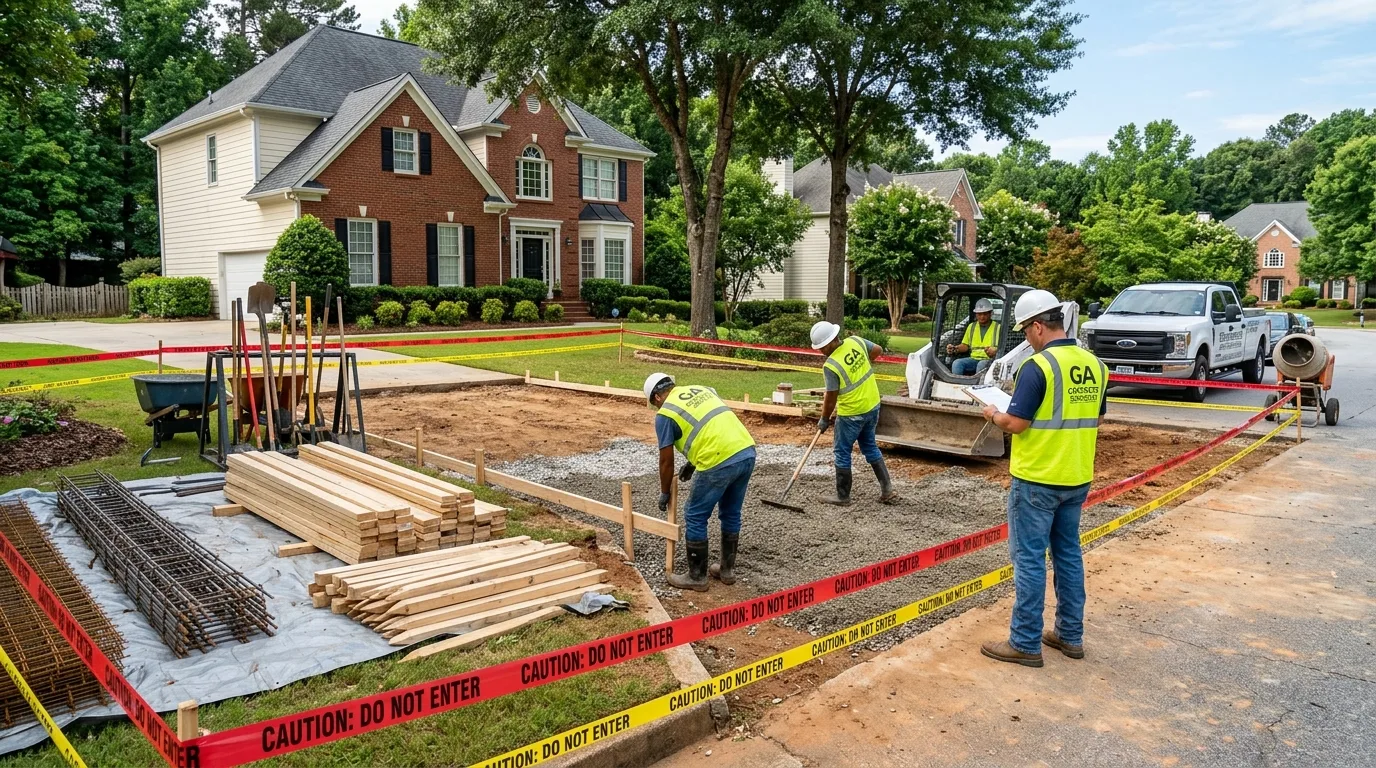
Concrete in Holly Springs, GA can last 30–50 years — or it can show significant deterioration in 10 years. The difference is almost entirely maintenance: sealing on the right schedule, addressing cracks promptly before water infiltrates and expands them, and understanding the specific seasonal threats that Georgia’s climate poses to concrete surfaces.
This guide gives Cherokee County homeowners a practical, season-specific maintenance framework for driveways, patios, slabs, and sidewalks.
Concrete Maintenance & Repair in Holly Springs
Free assessments for sealing, crack repair, and resurfacing. Call Holly Springs Concrete at (888) 376-0955.
Why Concrete Maintenance Matters in Holly Springs
Georgia’s climate is harder on concrete than most homeowners expect. The combination of intense summer UV, frequent rain cycles that test drainage design, mild winters with occasional hard freezes, and Cherokee County’s clay soil that exerts pressure on slab undersides creates more surface stress than a dry-climate concrete surface experiences. The result is predictable deterioration on unmaintained concrete — surface scaling, UV-faded color (on stamped or colored concrete), and widening cracks that allow water to infiltrate and reach the sub-base.
The good news is that the maintenance required to prevent all of this is relatively simple and inexpensive when done on schedule. Sealing every 3–5 years (not every 10, as northern climate guides often suggest) costs $150–$400 for a standard driveway and dramatically extends surface life. Addressing cracks when they’re under 1/4 inch — a $100–$300 repair — prevents the sub-base erosion that turns a simple crack into a slab replacement at $3,000+.
Types / Options: Maintenance Tasks and Their Timing
Concrete sealing: The single most important maintenance task for Holly Springs concrete. A penetrating or surface-applied acrylic sealer protects against UV degradation (which breaks down cement paste), water infiltration (which erodes sub-base and expands cracks in freeze-thaw), and surface staining. For plain concrete, seal every 3–5 years. For stamped and colored concrete, seal every 2–3 years — the color protection is particularly important in Georgia’s intense sun. Apply after the concrete has fully cured (28 days minimum) and when surface temperatures are 50–80°F. Fall is the ideal sealing season in Holly Springs.
Crack inspection and filling: Inspect your concrete surfaces annually — a spring walk-through after winter and a fall inspection before the wet season are both useful. For cracks under 1/4 inch and not actively growing, polyurethane crack filler applied by a homeowner or professional stops water infiltration. For cracks wider than 1/4 inch, actively growing cracks, or cracks with settlement at the edges, call for a professional assessment — these require root cause evaluation before simple filling is appropriate.
Surface cleaning: Pressure washing every 1–2 years removes organic debris, algae, and surface contamination that can stain concrete and degrade sealer. Holly Springs’s humid climate and tree canopy (particularly in neighborhoods like Barrett Farms and Creekwood) accelerate organic buildup on patio and driveway surfaces. Clean before resealing — sealing over debris reduces sealer adhesion and longevity.
Drainage maintenance: Concrete doesn’t fail in isolation — it fails when the sub-base beneath it fails. Maintain drainage away from concrete surfaces: keep gutters and downspouts directing water away from driveways and patios, confirm that grade adjacent to concrete still slopes away from the surface (soil settles over time and can redirect flow), and clear debris from drainage channels that carry water away from patios.
Practical Uses: Seasonal Maintenance Calendar for Cherokee County
Spring (March–April): Conduct your annual inspection after winter. Look for new cracks, especially after any hard freeze episodes. Check for settled sections (walk the entire surface — soft spots that flex underfoot indicate voids beneath). Check drainage — pour water on the surface and confirm it flows away from the house and doesn’t pool. Clear debris from winter that’s been deposited on concrete surfaces. If crack filling is needed, spring temperatures (55–70°F) are ideal for sealant cure.
Summer (June–August): Avoid resealing in peak summer heat — most sealers perform best when applied at surface temperatures below 90°F. Instead, focus on cleaning and damage assessment. Tree sap, bird droppings, and rubber tire marks are more common in summer; address staining promptly before it sets. Check stamped concrete color — if fading is noticeable, schedule a fall resealing.
Fall (September–October): The ideal maintenance window in Holly Springs. Fall is the best season for resealing concrete — temperatures are moderate, humidity is lower than spring, and there are typically consecutive dry days without the summer thunderstorm frequency. Apply sealer after a thorough pressure wash and at least 24 hours of dry surface. Address any crack filling before sealing. This window also applies to larger repair work like resurfacing — concrete repair services are in high demand in fall; book early.
Winter (December–February): Avoid applying de-icing salt to Holly Springs concrete — salt accelerates surface scaling. Holly Springs rarely gets significant ice accumulation, but if needed, use sand or ice melt products labeled as concrete-safe. Inspect for any new cracking after hard freeze episodes. Winter is acceptable for small crack repairs when temperatures stay above 40°F during application and cure.
How It Works: Sealer Selection for Georgia Concrete
Not all sealers are equal in Georgia’s climate. The two main categories:
Penetrating sealers (silane/siloxane-based): Soak into the concrete surface rather than forming a surface film. Excellent water repellency without changing the concrete’s appearance. Longer-lasting (5–7 years in Georgia vs. 3–5 for surface sealers), but don’t provide UV protection for color (important for stamped concrete). Best choice for plain concrete driveways and walkways where appearance-neutral protection is the goal.
Film-forming sealers (acrylic, polyurethane): Create a surface coating that provides UV protection and can enhance or maintain color. Essential for stamped and colored concrete. The trade-off is that surface films wear off faster in high-traffic areas and in Georgia’s UV intensity — every 2–3 years rather than 3–5. They also require re-application to maintain protection once worn.
For Holly Springs’s conditions: use penetrating sealers for plain concrete driveways and walkways; use UV-stable acrylic film sealers for stamped patios, decorative work, and any colored concrete. Apply in the fall window (September–October) when temperatures and humidity are optimal.
Schedule Your Holly Springs Concrete Maintenance
Sealing, crack repair, and resurfacing for Cherokee County homeowners. Free assessments — call (888) 376-0955.
Cost Factors for Concrete Maintenance in Holly Springs
Sealing costs (2026 Holly Springs market):
- Professional sealing of standard 600 sq ft driveway: $150–$400 depending on sealer type and surface condition
- Stamped patio sealing (400 sq ft): $200–$500 (film-forming sealers cost more per sq ft due to coverage rate)
- Pressure washing + sealing combo: add $75–$150 for pressure washing
Crack repair costs:
- Basic polyurethane crack fill (per linear foot): $3–$8/ft
- Professional crack assessment and fill for multiple cracks: $100–$400
- Slab-wide crack assessment and structural evaluation: $150–$300
The return on maintenance investment is straightforward: $300 in sealing every 4 years over 20 years costs $1,500. Neglecting maintenance and replacing a cracked, spalled driveway at year 15 costs $3,000–$4,200. Maintenance wins decisively. See our concrete repair services for larger repair scope and pricing.
Frequently Asked Questions
How often should I seal my concrete driveway in Holly Springs GA?
Every 3–5 years for plain concrete driveways in Holly Springs. Every 2–3 years for stamped or colored concrete. Georgia’s UV intensity is more aggressive than national guides (often written for northern climates) suggest — the 7-year sealing schedules common in the northeast don’t apply here. If water no longer beads on the surface, the sealer has degraded and it’s time to reseal.
What’s the easiest way to tell if my concrete needs maintenance attention?
Three tests: (1) Water test — pour a cup of water on the concrete surface. If it beads up, sealer is still active. If it soaks in within 30 seconds, sealer has degraded. (2) Look for cracks — any crack wider than a credit card thickness deserves attention. (3) Look for soft spots — walk the surface slowly; any flex or hollow sound when tapped indicates a void beneath the slab that needs investigation.
Can I seal my own concrete in Holly Springs?
Yes — homeowner-applied penetrating sealers work well for plain concrete driveways and walkways if the surface is properly cleaned first (pressure washed and fully dry). Film-forming sealers for stamped concrete are more technique-sensitive; professional application provides more consistent coverage and avoids lap marks that are visible on decorative surfaces. For crack filling, homeowner products work for hairline cracks; larger cracks benefit from professional evaluation and repair.
Related: