
Why Georgia Red Clay Matters for Holly Springs Concrete
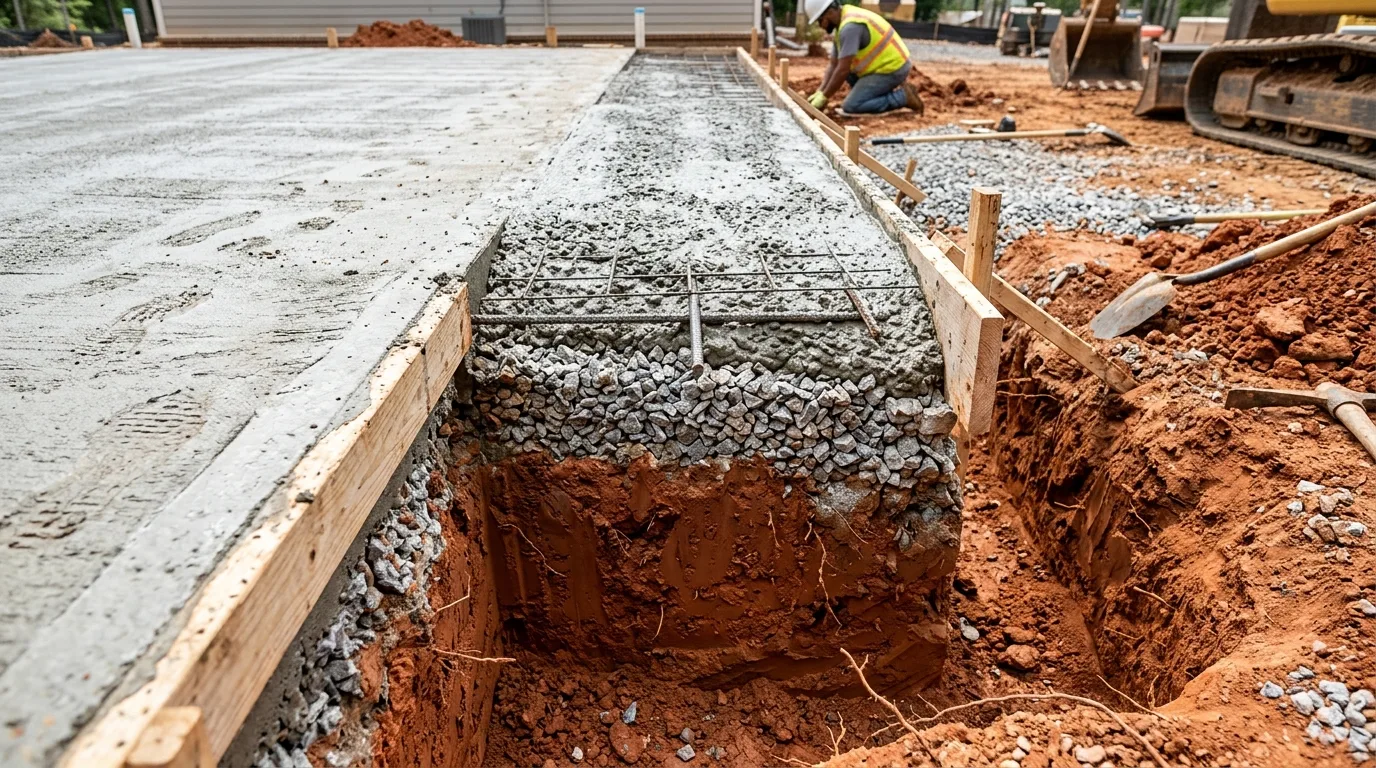
Walk any established neighborhood in Holly Springs — Barrett Farms, Creekwood, Cypress Springs — and you’ll find driveways with a story to tell. Some are cracked through the full depth after eight years. Others from the same era are clean and solid. The difference isn’t the concrete. It’s what’s beneath it.
In this post, we explain how Georgia’s red clay soil creates unique challenges for concrete in Holly Springs, GA, what proper base preparation actually requires, and why cutting corners on sub-base work costs Cherokee County homeowners far more in the long run.
Holly Springs Concrete That Handles Red Clay
Every project includes proper base engineering for Cherokee County soil. Call (888) 376-0955 for a free estimate.
Why Georgia Red Clay Matters for Your Concrete Project
Georgia’s red clay soil is classified as an Ultisol — highly weathered, acidic, and with very low permeability. The critical characteristic for concrete is its expansive behavior: clay swells significantly when wet and shrinks as it dries. In Cherokee County’s climate, this happens on a seasonal cycle.
During Holly Springs’s rainy season (spring and summer), the clay beneath driveways, patios, and slabs absorbs moisture and expands. As fall arrives and rainfall decreases, the clay dries and contracts. This cycle happens every year. Concrete sitting on unstabilized clay experiences differential movement — some sections pushing up as soil swells, others dropping as soil contracts — that generates tensile stress in the slab well beyond what concrete can resist without proper support.
The result is predictable: diagonal or transverse cracks that follow stress lines, settled sections where clay shrinkage created voids, and heaved sections where tree root systems displaced clay beneath the slab. Homeowners sometimes blame the contractor or the concrete quality. In most cases in Holly Springs, the failure was determined before the first truck arrived — by the base preparation decision.
Types / Options for Managing Red Clay Beneath Concrete
Compacted aggregate base: The most common and reliable solution for residential concrete in Cherokee County. A 4–6 inch layer of compacted #57 gravel or crush-and-run creates a stable, well-drained sub-base that maintains its bearing capacity regardless of clay moisture content. The aggregate provides drainage pathways that prevent water accumulation beneath the slab. This is the baseline we require for every residential driveway, patio, and slab in Holly Springs.
Deeper base for high-clay areas: Some properties in Barrett Springs and Crest Brooke have clay that runs 12+ inches below grade. These sites benefit from 6–8 inch aggregate bases rather than the standard 4 inches, with the additional depth creating a larger drainage buffer. The cost premium ($0.50–$1.00/sq ft) pays off in substantially longer slab life.
Lime stabilization: An alternative for commercial or heavy-load applications. Hydrated lime is mixed into the top layer of clay to chemically reduce its plasticity index. Used primarily for large commercial slabs; less common for residential work where aggregate bases are more cost-effective.
Geotextile fabric: Placed between the clay subgrade and aggregate base to prevent fines migration (clay particles working up into the gravel over time, reducing its drainage performance). Adds $0.10–$0.20/sq ft and is worth it on sites with particularly fine-grained clay.
Practical Uses: Where Red Clay Awareness Makes the Biggest Difference
Concrete driveways in wooded lots: Barrett Farms and Cedar Valley properties with mature trees face compounded challenges — clay movement plus root displacement. Both require a properly compacted aggregate base, rebar on 24-inch centers, and root barriers where major root systems are within 10 feet of the slab edge. This combination prevents the heaving and cracking that is common in unmanaged wooded lots.
Stamped concrete patios: Stamped concrete is particularly unforgiving of slab movement because cracks compromise the decorative finish in ways that are visually obvious and expensive to repair. Stamped patios on inadequate bases in Cherokee County fail faster than plain concrete because the surface sealer creates a vapor barrier that can trap soil moisture pressure beneath the slab. Every stamped patio we install includes a full 4-inch minimum aggregate base as standard.
Concrete foundations: Foundation failures in Holly Springs are almost always a red clay story. A slab-on-grade foundation built without adequate base preparation begins moving within 3–5 years as clay moisture cycles cause differential settlement. The repair cost dwarfs the upfront cost of proper base work. See our concrete foundations guide for Holly Springs for specifics.
Repair vs. replacement decisions: When a driveway or patio has cracked significantly in Holly Springs, the underlying cause is almost always clay movement. Surface patching without correcting the drainage or base issue results in the same cracking within 2–3 years. Our repair vs. replace guide covers when base investigation is necessary before any surface repair.
Concrete sidewalks near trees: Sidewalks in Creekwood and similar established neighborhoods often crack from root pressure combined with clay movement. Root removal before new concrete and a geotextile base prevent repeat failures.
How It Works: The Shrink-Swell Cycle in Cherokee County
Cherokee County’s average annual rainfall is approximately 52 inches, distributed fairly evenly but with peak rainfall in spring (March–April) and summer (June–August). This pattern drives a predictable shrink-swell cycle in the clay below concrete.
After significant spring rains, Cherokee County red clay can increase in volume by 5–10% in the top 18–24 inches. This upward pressure is distributed across the bottom of slabs. Where a slab is well-supported (over compacted aggregate), the pressure distributes evenly and the slab rises slightly as a unit. Where a slab has poor base support, the pressure distributes unevenly — causing sections to rise more than others, which generates bending stress that cracks the concrete.
In late summer and fall, the reverse happens. As clay dries, it shrinks and pulls away from the underside of slabs, creating voids. Slabs lose support over these voids and begin to crack from top-down loading. Sections that had been pushed up from below then drop as the clay contracts, leaving stepped cracks and settled sections that are classic signs of red clay movement without proper base engineering.
Holly Springs Concrete Built for Cherokee County Clay
Every driveway, patio, and slab includes proper base engineering for Georgia red clay. Free estimates — call (888) 376-0955.
Cost Factors Specific to Red Clay Sites
Standard base preparation adds $0.50–$1.50 per square foot to concrete project costs in Holly Springs compared to regions with better-draining soils. This covers deeper excavation, aggregate material cost, and compaction labor. On a 600-square-foot driveway, that’s $300–$900 in additional base cost.
This investment is not optional in Cherokee County — it’s the difference between a concrete project that performs for 30+ years and one that needs significant repair within a decade. The aggregate base cost is small relative to the concrete cost; skipping it to win a low bid is false economy that the homeowner pays for later. Properties in Woodstock or Acworth with similar clay profiles require the same approach.
Frequently Asked Questions
How do I know if my Holly Springs property has problematic red clay?
In Holly Springs, you can assume red clay is present — it’s the dominant soil across Cherokee County. Properties with orange or reddish soil visible at shallow depths (1–2 feet below surface grade) have classic Georgia Ultisol clay. Properties in low-lying areas or near drainage swales are particularly susceptible to clay saturation. All our concrete projects include a site assessment that identifies sub-base conditions before we spec the base depth and reinforcement.
Can red clay cause existing concrete to fail after many years?
Yes — and this is one reason why Holly Springs driveways that lasted 20+ years without cracking can suddenly show rapid deterioration. As clay below slabs dries out (sometimes accelerated by drought or changes in nearby tree root water demand), voids form that previously weren’t there. Sealing your concrete and ensuring drainage stays functional are the best long-term prevention strategies. Read our seasonal concrete maintenance guide for specifics.
How do I find a contractor who understands Georgia red clay in Holly Springs?
Ask any contractor specifically: “What base depth do you use for driveways in Cherokee County, and how do you handle Georgia red clay?” A contractor with genuine local experience will answer with specific numbers (4–6 inches of compacted aggregate, rebar on 24-inch centers) and may ask about tree proximity. A contractor without local experience will give a generic answer. Get this commitment in writing in the estimate.
Related: