
Concrete Permits in Holly Springs GA — What You Need
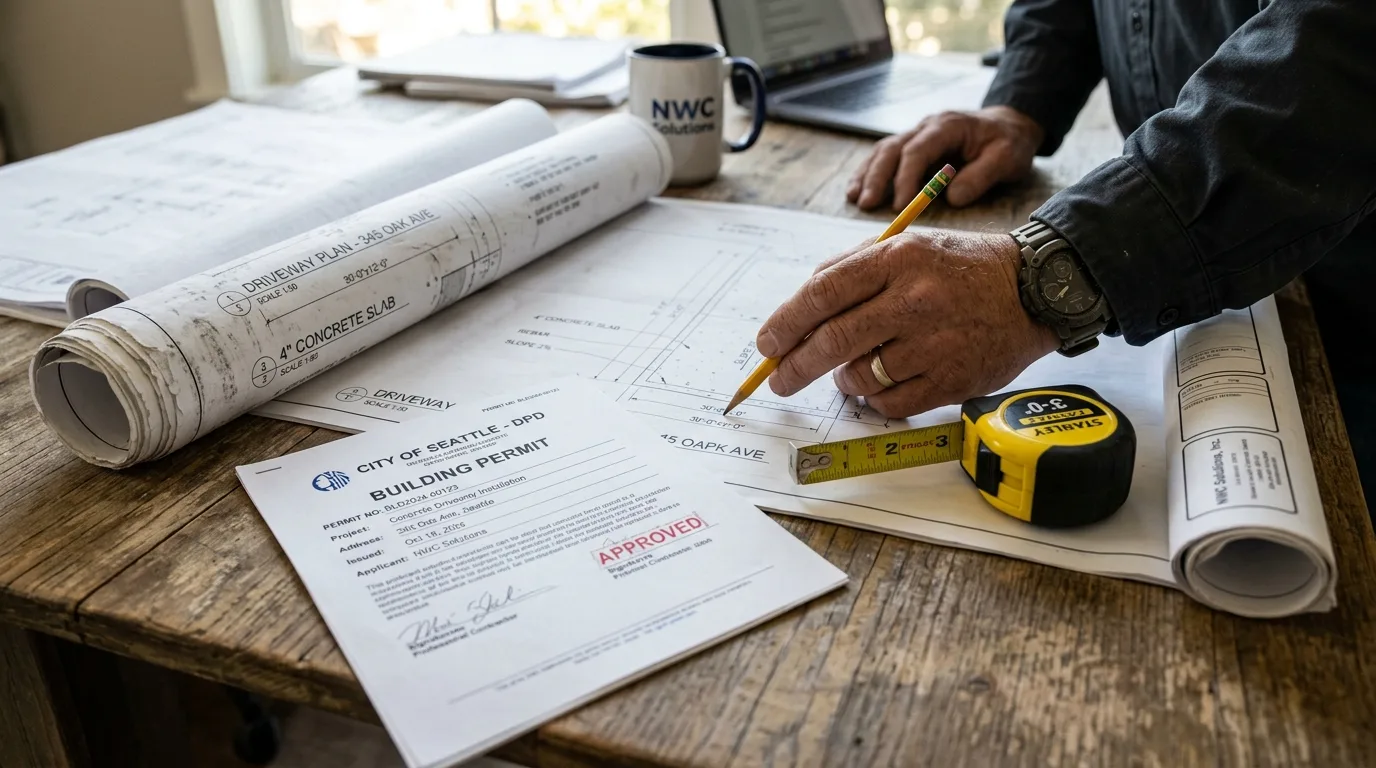
One of the most common questions we receive from Holly Springs homeowners is whether their concrete project needs a permit. The answer depends on three things: what you’re building, how big it is, and where your property sits in relation to Holly Springs city limits. This guide walks through the permit requirements for every common concrete project type in Holly Springs and Cherokee County.
Permit Guidance for Your Holly Springs Concrete Project
We handle permit coordination as a standard part of our service. Free estimates — call (888) 376-0955.
Why Concrete Permits Matter in Holly Springs
Skipping a required permit isn’t just a code violation — it’s a property liability. Unpermitted work can complicate home sales (buyers’ lenders often require unpermitted work to be permitted or removed before closing), can void homeowner’s insurance claims if damage relates to unpermitted construction, and can result in a stop-work order or required demolition if discovered during a property inspection. In Holly Springs’s growing real estate market, unpermitted concrete is an increasing issue that buyers and their agents are catching more frequently.
The permit process also provides a benefit beyond liability protection: required inspections catch sub-base and reinforcement problems before concrete is poured over them. A footing inspection that catches an inadequate base prep protects the homeowner from a concrete failure they’d otherwise discover 5 years later.
Types / Options: Which Authority Permits Your Project?
This is the first question for any Holly Springs concrete project — and the answer depends on your address.
Projects within Holly Springs city limits: Permitted through the City of Holly Springs. The city’s community development department handles residential and commercial permits, plan review, and inspections. City of Holly Springs adopted the 2018 International Residential Code and International Building Code with Georgia amendments.
Projects in unincorporated Cherokee County: Permitted through the Cherokee County Development Service Center (DSC). The DSC handles all permits in unincorporated county areas and for the City of Waleska. Adopted codes: 2018 IBC/IRC, 2020 National Electrical Code, 2015 Energy Conservation Code with Georgia amendments.
How do you know which applies to your address? Your property tax bill shows the jurisdiction. If you’re uncertain, the Cherokee County GIS mapping tool can confirm your parcel’s jurisdiction. When in doubt, call us — we’ve been doing this long enough to know which neighborhoods fall under which authority.
Practical Uses: Permit Requirements by Project Type
Concrete driveways: Permit requirements for driveways depend on size and whether they connect to a public street. Driveways 120 sq ft or larger within Holly Springs city limits typically require a building permit. Driveways connecting to a public street may also require a separate driveway cut permit from the city or county public works department. In unincorporated Cherokee County, similar size thresholds apply. Some smaller driveway additions (widening strips, short approach pads) may fall below the threshold — confirm for your specific scope.
Concrete patios: Patios 120 square feet or larger require a building permit in Holly Springs. Patios under 120 sq ft may be exempt, but this threshold can be interpreted differently for covered vs. uncovered patios and patios attached to the structure. HOA communities like Barrett Springs may require architectural review board (ARB) approval regardless of permit requirements.
Concrete slabs (garage, shed, workshop): Structures 120 sq ft or larger require permits in both Holly Springs city and Cherokee County. Attached garage slabs require a permit as part of the addition. Detached garages and workshops require permits if 120 sq ft or larger. Even “simple” shed pads of 120+ sq ft need permits — the building that sits on the slab determines the permit requirement.
Concrete foundations (house or major structure): House foundations and foundations for major additions always require permits, regardless of size. These projects require plan review and multiple inspections: footing inspection before pour, foundation inspection before backfill, and final inspection at project completion. Engineer-stamped drawings are typically required.
Retaining walls: Retaining walls have their own permit category in Cherokee County. Walls over 4 feet in height (measured from bottom of footing to top of wall) typically require a permit and may require engineer review depending on the soil load. Walls under 4 feet may be exempt, but check with the jurisdiction for your project’s specific conditions.
Commercial concrete: All commercial concrete work — parking lots, sidewalks, dumpster pads, ADA ramps, curb-and-gutter — requires commercial permits. ADA-compliant work requires compliance with the Georgia Accessibility Code in addition to building permits. Commercial projects require commercial plan review and may require PE-stamped drawings.
How It Works: The Permit Process for Holly Springs Concrete
For a standard residential concrete project (driveway or patio), the permit process in Holly Springs typically involves:
- Permit application submission — online or in-person at the city or county office
- Plan review — for simple flatwork, this is often a counter review (same day); for foundations and commercial work, allow 5–15 business days
- Permit issuance and fee payment
- Required inspections during construction (footing inspection before pour for foundations; final inspection for flatwork)
- Certificate of completion (for projects requiring final inspection)
Permit fees in Holly Springs and Cherokee County are based on project valuation. Residential driveway and patio permits typically cost $100–$300; foundation permits cost $200–$500 depending on scope. We handle permit submissions and inspection scheduling as a standard part of our service for permitted projects — you don’t need to navigate this process alone.
We Handle Holly Springs Concrete Permits for You
No permit confusion — we advise, submit, and coordinate inspections. Call (888) 376-0955 for a free estimate.
Cost Factors for Permitted Concrete Projects
Permitted projects cost slightly more than unpermitted work because they include permit fees and the additional time for inspection coordination. Permit fees for typical residential projects run $100–$500 depending on project scope. Inspection scheduling adds 3–7 days to the project timeline on projects requiring footing inspection before pour.
However, the cost of unpermitted work catching up with a homeowner — required demolition, re-permitting, and reconstruction — far exceeds the original permit cost. We recommend permitting all applicable projects and including permit costs in the project estimate from the start.
Frequently Asked Questions
What happens if I do concrete work without a required permit in Holly Springs?
Unpermitted work that’s discovered can result in a stop-work order, fines from the city or county, and in some cases a requirement to expose or remove the work for inspection before re-permitting. More practically, unpermitted work often surfaces during home sales — buyers’ inspectors and lenders check permit records, and unpermitted improvements must be disclosed or remediated. The permit process exists to protect you as much as the public.
Does a Holly Springs permit requirement apply to HOA communities like Barrett Springs?
Yes — city and county permit requirements apply throughout Holly Springs regardless of HOA status. HOA architectural review board approval is a separate requirement that applies in addition to (not instead of) government permits. If your project needs both, we advise on both processes during the estimate. ARB timelines vary by HOA; plan for 2–4 weeks for ARB review before permit submission.
How do I find out if my Holly Springs property needs a city or county permit?
Your property tax bill shows the billing jurisdiction — if it lists “City of Holly Springs,” you use city permits. If it lists “Cherokee County” without a city designation, you use the Cherokee County Development Service Center. Cherokee County’s GIS parcel mapping is also available online. We confirm jurisdiction for every project during the estimate site visit — no guesswork.
Related: